3 months to break into AI: the skills AI jobs actually ask for
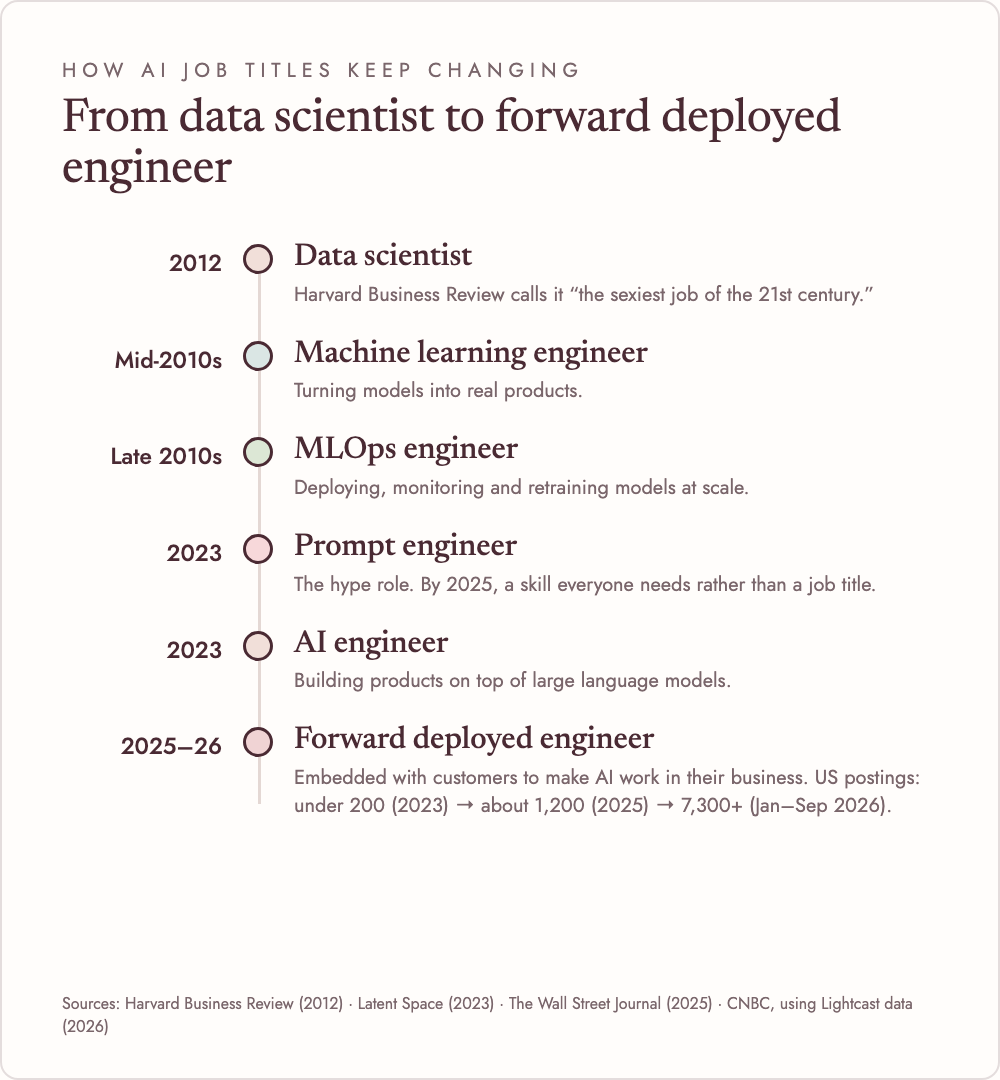
In 2012, Harvard Business Review called data scientist the sexiest job of the 21st century. Everyone wanted to be one.
A few years later, companies realised that a model sitting in a notebook doesn't help anyone, and the machine learning engineer appeared: the person who turns models into products. Then came MLOps engineers, who keep those models running.
In 2023, ChatGPT arrived and suddenly everyone was hiring prompt engineers. By 2025, the Wall Street Journal was calling it the hottest AI job of 2023 that was already obsolete. Writing good prompts didn't disappear. It just became a skill everyone is expected to have, not a job title.
The same year, Shawn Wang (swyx) wrote about the rise of the AI engineer: software engineers who build products on top of large language models. And now, in 2026, the title everyone is talking about is the forward deployed engineer.
The tools keep changing. The job titles keep changing. The core skills underneath them have barely changed at all. That's what this post is about, along with a realistic 3-month plan to build them.
How AI job titles have changed
What is a forward deployed engineer?
A forward deployed engineer (FDE) works directly with a customer, inside their business, to make AI actually work for them. Part engineer, part consultant: you understand the customer's problem, build the solution with their data and systems, and make sure it gets used.
It's growing fast. According to Lightcast data reported by CNBC in October 2026, US job postings for FDEs went from fewer than 200 in 2023 to around 1,200 in 2025, and more than 7,300 in just the first nine months of 2026, with a median advertised salary of about $195,000. AI companies and consulting firms are investing heavily in training thousands of them.
Why does this matter for you? Because companies have realised that building an AI model is the easy part. Making it useful for real people is the hard part. The skills that get you hired today are the ones that bridge that gap.
AI jargon, in plain words
Job descriptions are full of terms that sound scarier than they are:
- Machine learning (ML): teaching a computer to find patterns in data instead of writing every rule by hand.
- Deep learning: machine learning with neural networks, which power image recognition, speech and language models.
- LLM (large language model): the kind of model behind ChatGPT, Claude and Gemini.
- RAG (retrieval-augmented generation): letting an LLM look things up in your own documents before it answers.
- Fine-tuning: further training an existing model on your own data so it gets better at one task.
- Agents: AI systems that can take steps on their own, such as searching, calling tools or writing code.
- Evals (evaluation): tests that show, with numbers, how well your model or AI app works.
- MLOps: everything needed to keep models running reliably in production.
The AI jobs, in plain words
- Data analyst: answers business questions with data. SQL, spreadsheets, dashboards, some Python. A common way in.
- Data scientist: builds models to predict things and explain patterns. Statistics, Python and machine learning.
- Machine learning engineer: turns models into reliable products. Strong software engineering plus ML.
- AI engineer: builds applications on top of large language models, such as chat assistants, search over documents, and agents.
- Forward deployed engineer: builds AI solutions directly with customers. Engineering skills plus communication.
- Research scientist: invents new methods. Usually needs a PhD (that's my world; more in From research to the real world).
Pick the one that excites you most. The plan below works for all of them.
The skills employers keep asking for
Core
- Python: comfortable, not just copy-paste.
- SQL: almost every data and AI job uses it, and beginners often skip it.
- Statistics and ML basics: what a model is learning, how to evaluate it, and when it's overfitting.
Modern AI
- Deep learning with PyTorch: training a simple network yourself.
- Building with LLMs: prompting, embeddings, RAG and agents.
- Evaluation: proving your AI app works, with numbers.
Engineering
- Git and GitHub: your work should live somewhere people can see it.
- APIs and Docker: so your project runs outside your laptop.
- One cloud platform, at a basic level: AWS, Google Cloud or Azure.
The ones that matter more every year
- Explaining your work clearly to people who aren't technical.
- Understanding the business problem: why a model matters to the people using it. This is exactly what the forward deployed engineer role is built on.
An honest note on "3 months"
Three months of focused work won't make you an AI expert. What it can do is take you from "I've done some tutorials" to "I can build and explain real AI projects," which is what gets you interviews. It works best if you already know a bit of programming, or you're an engineer, analyst or student moving into AI. If you're starting from zero, read my beginner's guide to AI first.
The big picture: your 12-week plan
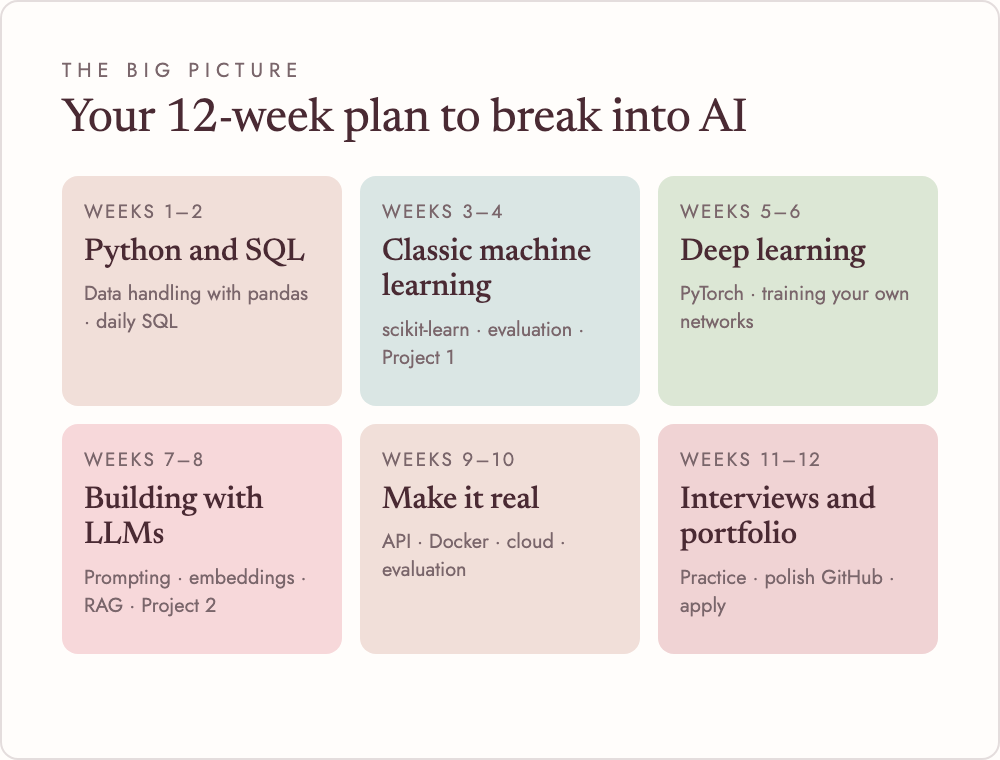
Weeks 1–2: Python and SQL
- Python for data with pandas. Start with my Python playlist or the free Kaggle Learn Python and pandas courses.
- Write SQL queries every day (Kaggle Learn has an intro to SQL too).
Weeks 3–4: Classic machine learning
- Andrew Ng's Machine Learning Specialization (you can audit it for free) or Google's Machine Learning Crash Course.
- Practise with scikit-learn, and watch my Machine Learning playlist alongside.
- Project 1: a prediction model on a real dataset, with a clear write-up of what you found.
Weeks 5–6: Deep learning
- Practical Deep Learning for Coders from fast.ai, or the Deep Learning Specialization.
- PyTorch tutorials and my Deep Learning & LLMs playlist.
Weeks 7–8: Building with LLMs
- The free Hugging Face courses, DeepLearning.AI short courses on RAG and agents, and DataTalksClub's free LLM Zoomcamp.
- Project 2: an app that answers questions about documents you care about, such as your university's course handbook or a set of research papers.
Weeks 9–10: Make it real
- Put Project 2 behind an API, package it with Docker, deploy it to the cloud, and measure how well it answers.
- Full Stack Deep Learning and the MLOps Zoomcamp cover this part well. This is what separates you from most applicants.
Weeks 11–12: Interviews and portfolio
- Polish your GitHub, write a short post about each project, and update your resume.
- Prepare for interviews with my guide: How to prepare for tech interviews in the US.
For a map of everything an AI engineer is expected to know, roadmap.sh's AI engineer roadmap is helpful. Use it as a reference, not a checklist.
What makes a portfolio stand out
- Two or three finished projects beat ten half-done ones.
- Every project has a clear README: the problem, your approach, the results, and how to run it.
- Show numbers: "answers 85% of test questions correctly" is far stronger than "works well."
- Solve a real person's problem. That's the forward deployed mindset, and hiring managers notice it.
Getting hired
- Match your resume to the job description. Use the same words for the skills you genuinely have.
- Look beyond the title. The same work might be called AI engineer, ML engineer, applied scientist or forward deployed engineer. Read the description, not just the title.
- Ask for referrals. A short, specific message on LinkedIn works more often than you'd think.
- Contribute to open-source AI projects. Even a small documentation fix gets your name in front of the people who build the tools.
- Learn in public. Share what you build. It's how the right people find you.
Where this fits on the blog
- New to AI? Start with A beginner's guide to AI.
- Curious about research? Read From research to the real world.
- Getting ready for interviews? How to prepare for tech interviews in the US.
- Want to watch along? All my LEVEL UP playlists are on YouTube.
Let's do this together
Job titles will keep changing. In two years there will probably be a new one we haven't heard of yet. But if you can code, understand the data, build something real and explain why it matters, you'll be ready for whatever it's called.
If you're starting your 3 months, write to me and tell me which role you're aiming for. I'd love to hear what you build.
Start small, stay consistent, and level up. ♡