
How to prepare for tech interviews in the US: skills, process and an 8-week plan
I've interviewed at Meta, Amazon and Microsoft, for both internship and full-time roles. I didn't get the offers. But every single round taught me something, and one thing became very clear: in the US, big tech interviews follow almost the same structure everywhere. Once you understand that structure, preparing gets much less scary.
This post is my compact guide: how the process works, what each round tests, an 8-week plan you can follow, and the lessons I learned the hard way. It works for most major companies, including Google, Apple, Netflix, Nvidia, Meta, Amazon and Microsoft.
The big picture
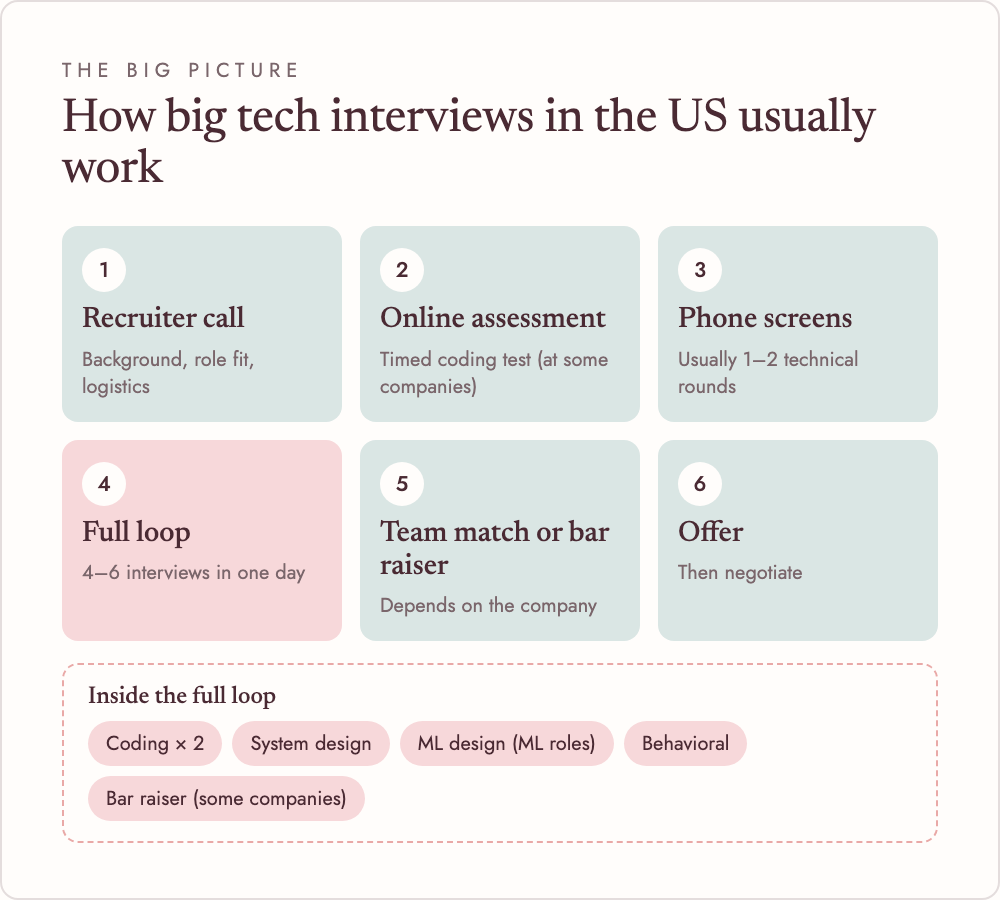
Most big tech companies start with a recruiter call, sometimes an online coding test, and then one or two technical phone screens. If those go well, you're invited to a "full loop": four to six interviews in one day covering coding, system design, machine learning design for ML roles, and behavioral questions. After the loop, some companies match you with a team, and some include a "bar raiser" interviewer whose job is to keep the hiring standard high. Then comes the offer.
The process, step by step
- Recruiter call. Your background, why this role, and logistics such as location, start date and work authorization.
- Online assessment (at some companies). A timed coding test, often on HackerRank or CodeSignal.
- Phone screens (usually one or two). Live coding with an engineer, typically 45 to 60 minutes each.
- The full loop. Four to six back-to-back interviews, often virtual:
- Coding (usually two rounds)
- System design for mid-level and senior roles
- ML system design and ML fundamentals for data and ML roles
- Behavioral: how you work with people and handle challenges
- Team matching or bar raiser. At some companies, you're matched with a team after you pass the loop. At others, one interviewer in the loop is a "bar raiser" from outside the team.
- Offer. Then you can negotiate.
What each round tests
Coding: data structures and algorithms
These are the topics to cover, roughly in this order:
- Arrays and strings: two pointers, sliding window, prefix sums
- Hash maps and sets
- Stacks and queues: including the monotonic stack
- Linked lists: fast and slow pointers
- Binary search: including binary search on the answer
- Trees: traversals, binary search trees
- Graphs: BFS and DFS, topological sort, union-find
- Heaps: top-k problems, merging intervals
- Recursion and backtracking
- Dynamic programming: 1D and 2D
Recognising the pattern behind a problem matters more than memorising solutions. And talk through your thinking while you code.
System design
How you'd build something like a URL shortener, a news feed or a chat app. Know the building blocks: APIs, SQL vs NoSQL databases, caching, load balancers, message queues and sharding, and be ready to discuss trade-offs.
ML system design (for ML and data roles)
Many companies expect you to follow a clear framework. A common one:
- Clarify the problem and how success is measured.
- Frame it as an ML problem: what are you predicting, and from what?
- Data and features: where the data comes from and how you'd prepare it.
- Model: start simple, then explain how you'd improve it.
- Evaluation: offline metrics, then online testing such as A/B tests.
- Serving: how predictions reach users, and how fast.
- Monitoring: catching drift and retraining.
Practise with classic questions such as "Design a recommendation system" or "Design search ranking."
Behavioral
Questions like "Tell me about a time you disagreed with a teammate." Answer with the STAR structure: the Situation, the Task, the Action you took, and the Result. Prepare six to eight real stories you can adapt. Reading Amazon's leadership principles is good practice for any company.
Your 8-week plan
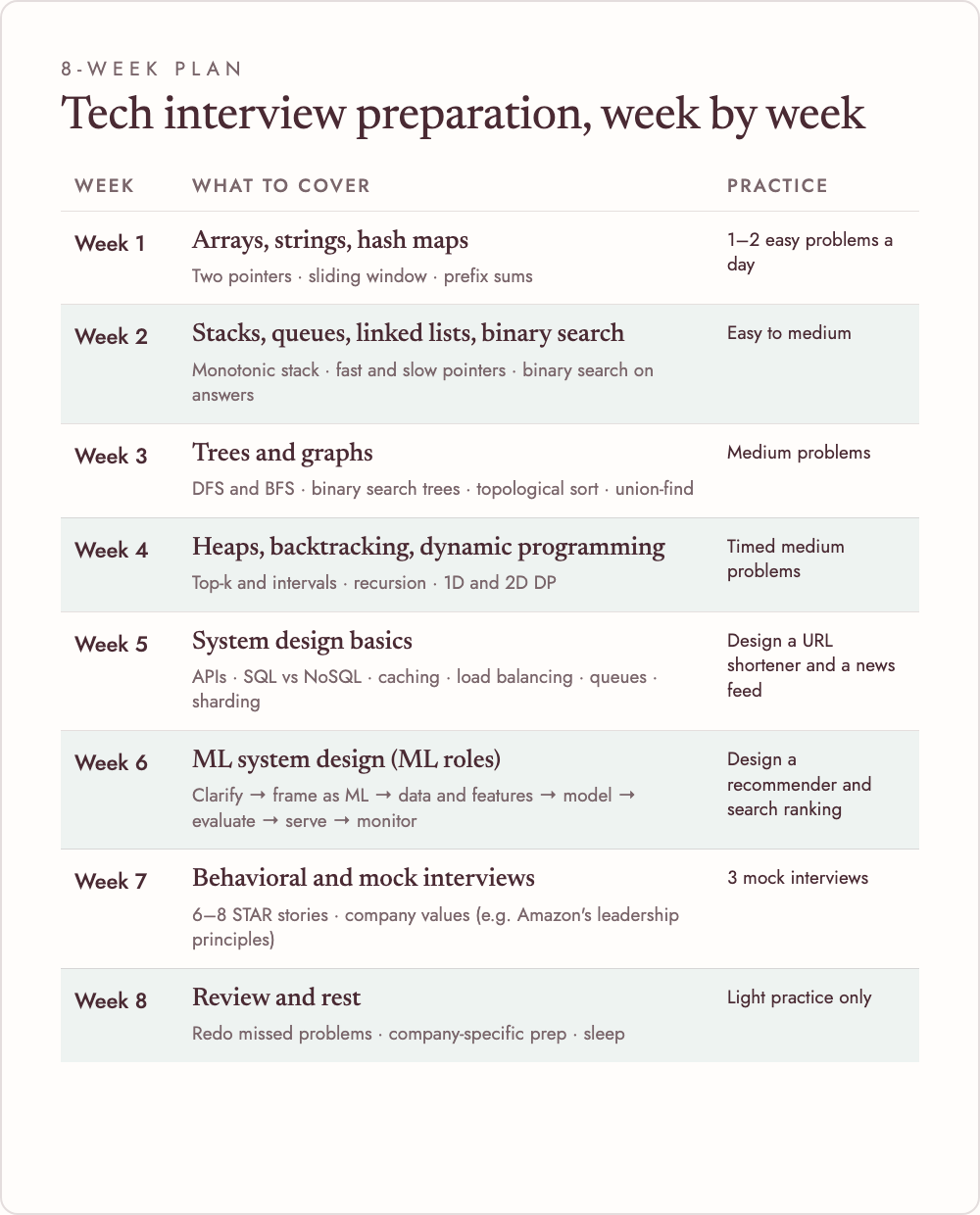
Download the 8-week plan as an Excel file and tick off each week as you go.
An hour a day for eight weeks will take you further than a frantic last weekend.
Where to practise
- LeetCode and the NeetCode roadmap for coding by pattern.
- ByteByteGo for system design.
- Machine Learning Interviews on GitHub for ML topics.
- Exponent or a friend for mock interviews.
- My LeetCode & DSA playlist on YouTube.
Want my full resource list? It covers coding, system design, ML design, behavioral and mock interviews, with the books and courses I use. Message me "PREP" on Instagram and I'll send it to you.
On the day
- Ask clarifying questions before you start.
- Think out loud. Interviewers want to see how you reason.
- Start simple, then improve. A working solution you then optimise beats a perfect idea you never finish.
- Test your code with a small example before saying you're done.
- Getting stuck is normal. Say what you're thinking, and take hints well.
If you're an international student
Be clear and honest about your work authorization when recruiters ask. Many F-1 students work after graduation on OPT, and STEM graduates may be eligible for a 24-month STEM OPT extension. Ask early whether a company sponsors work visas, and check your university's international student office for the latest rules.
More in Studying abroad from India: an honest guide to a funded PhD in the US, and if you're still building your skills, start with 3 months to break into AI.
What I learned from interviewing at Meta, Amazon and Microsoft
I didn't get an offer from these loops, and I won't pretend that didn't sting. But looking back, here's what I'd tell anyone preparing:
- Patterns beat memorising. The questions were never exactly ones I'd practised. What helped was recognising the pattern underneath: sliding window, BFS, a heap.
- Silence is your enemy. Interviewers can only score what they hear. Talk through your thinking, even when you're unsure.
- The behavioral round is not a "soft" round. It carries real weight, especially at Amazon, where the leadership principles come up in almost every interview. Prepare your stories as seriously as your coding.
- Practising alone isn't the same as being interviewed. Solving a problem quietly at home feels very different from solving it with someone watching the clock. Do mock interviews.
- Internship and full-time loops feel different. Internship interviews focus mostly on coding. Full-time loops add system design or ML design and go deeper on behavioral questions.
- A rejection is not the end. Many people interview with the same company more than once. Ask your recruiter for feedback, note what went wrong, and reapply when you're allowed to.
Every loop is practice for the next one. That's how I see it now.
Coming up next
I'm writing separate posts on my full experience with each company:
- Full loop interview experience: Meta
- Full loop interview experience: Amazon
They'll go round by round, and most of it applies to other big tech companies too.
Your turn
What's the hardest part of interviews for you: coding, system design, or the nerves? Comment or reach out if you'd like a guide for a specific company or role. I'm always happy to help, and your questions will shape future posts.
Prepare well, then trust yourself. ♡