Studying abroad from India: an honest guide to a funded PhD in the US
Almost every week, someone from India asks me: "How do I study abroad? And how do I pay for it?"
This is my honest answer, focused on the place I know: the United States. If you're in science or engineering, a PhD here can be fully funded. You don't need a huge loan. You do need to understand how funding works, and to start early.
The big picture
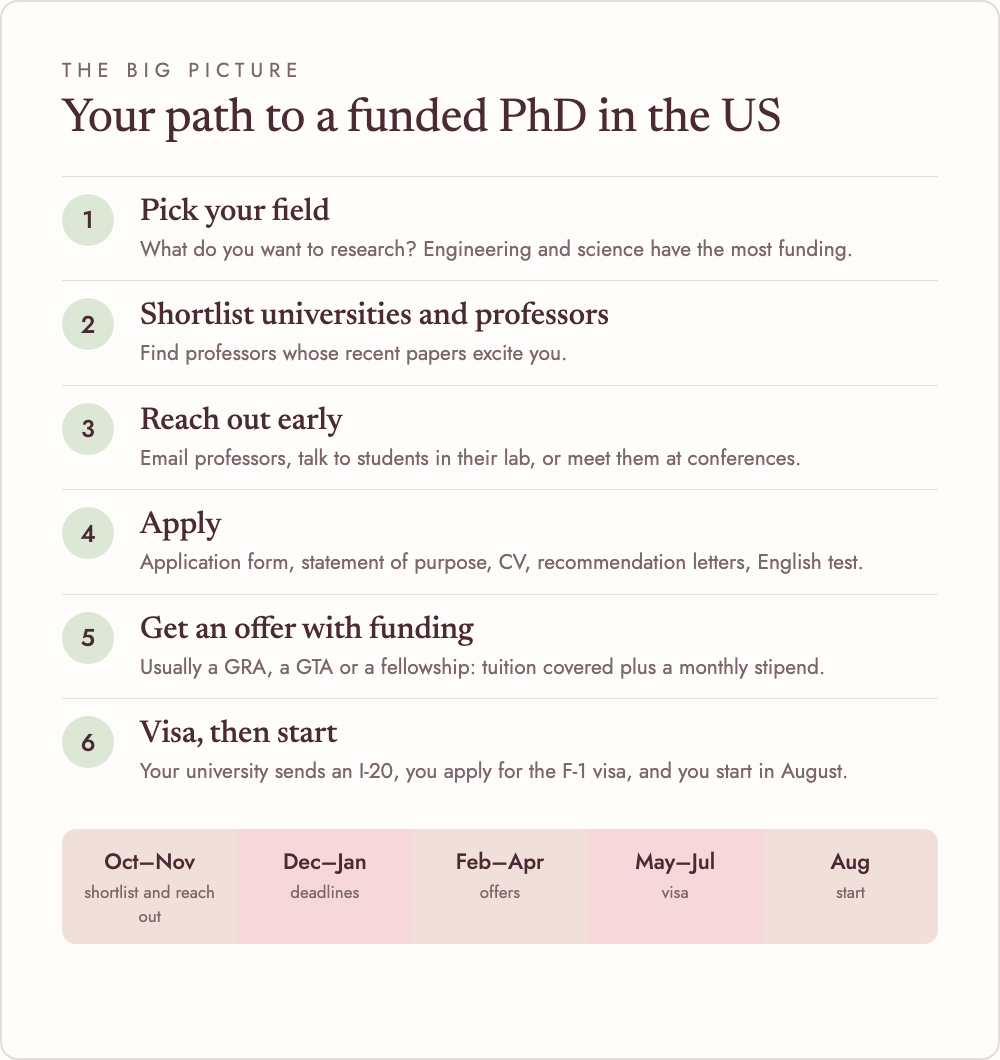
In one paragraph: pick your field, shortlist universities and professors, reach out to professors before you apply, then send strong applications. If a professor or department wants you, the offer usually comes with funding (a research or teaching assistantship) that covers your tuition and pays you a monthly stipend. Then you get your student visa and start in August.
Why now is a good time to think about a PhD
Honestly, the last couple of years have been hard for research funding in the US. Agencies such as NIH and NSF awarded far fewer research grants than in previous years (AIP).
But new money is flowing into some fields, especially AI, energy and power systems:
- The Genesis Mission. In November 2025, a US executive order launched the Genesis Mission, a Department of Energy initiative to use AI to speed up scientific discovery. In its first funding round, DOE received more than 5,000 applications and funded 278 projects led by national labs, universities and companies (UT News).
- New PhD programs. DOE announced a $100 million Genesis Mission Graduate Fellowship for accelerated four-year PhDs in AI and science or engineering, starting with a $20 million pilot, and NSF announced a six-year bachelor's-to-PhD program called NextGen Workforce (AIP).
- Professors are hiring. In my own field, I see more and more professors posting funded PhD openings, especially in power systems, energy and AI. I share the ones I come across on my LinkedIn.
Fields with a lot of scope right now
- Computer science: AI, machine learning, data science, cybersecurity.
- Electrical engineering: power systems, energy, the electric grid, semiconductors.
- Chemical engineering: energy, materials, batteries.
- Biology and agriculture: biotechnology, food and crop science, AI for biology.
Skills that make you a strong PhD applicant
- Programming: Python at least. MATLAB or C++ helps in engineering.
- Maths and statistics: the foundation for almost every field above.
- Machine learning and data analysis: now useful in nearly every science and engineering field.
- Research experience: a project, a thesis, an internship, or a paper, even a small one.
- Writing and communication: your statement of purpose and your emails to professors are your first research writing.
Where to study: the United States
Since I'm in the US, this guide covers the US. I'll write about other popular destinations in future posts.
To explore universities, US News Best Graduate Schools lets you browse programs by field. For computer science research specifically, CSRankings shows which universities are most active in each research area.
Rankings are only a starting point. For a PhD, the professor you work with matters more than the university's name.
How to apply, step by step
- Shortlist universities. Look for departments with several professors working on topics that excite you.
- Read the professors' recent work. What are they researching right now? Does your experience connect to it?
- Reach out before you apply. This is the step most people skip, and it makes the biggest difference:
- Email the professor. Keep it short: who you are, which of their recent papers interested you and why, how your background fits, and your CV attached. Ask if they're taking new students.
- Talk to students in the lab. They'll tell you honestly what the professor is working on, whether there's funding, and what the lab is like.
- Meet professors at conferences. If you're presenting your own research, conferences are one of the best places to meet them in person.
- Prepare your application. The online application form, your statement of purpose, CV, recommendation letters, and an English test (TOEFL or IELTS). Check whether each program wants the GRE; many no longer require it.
- Apply before the deadlines. For Fall 2027, most fall between December 2026 and January 2027.
No research background yet? You can still get there, but the path looks different. I'll cover it in a separate post, so send me your questions.
Master's or PhD?
- A master's is mostly self-funded. Most master's students pay their own tuition, often with an education loan. But once you're enrolled, you can look for a research or teaching assistantship on campus, and some students do find one.
- A PhD is usually funded through a research or teaching assistantship, which typically covers tuition and pays a monthly stipend.
- Some students come through Fulbright. The Fulbright-Nehru Master's Fellowships fund a master's in the US for Indian citizens. They're aimed at people with at least three years of work experience who plan to return to India, so check the eligibility on the USIEF site.
Who pays for a PhD?
A funded PhD isn't "free money." It's usually paid for by research grants.
Professors apply for grants from government agencies and other funders to run research projects. When a grant comes through, they hire PhD students to work on that project, and the grant pays the student's tuition and stipend. Sometimes students also help their professor write the grant that ends up funding their own PhD.
My PhD was also funded this way, through a grant from the US National Science Foundation.
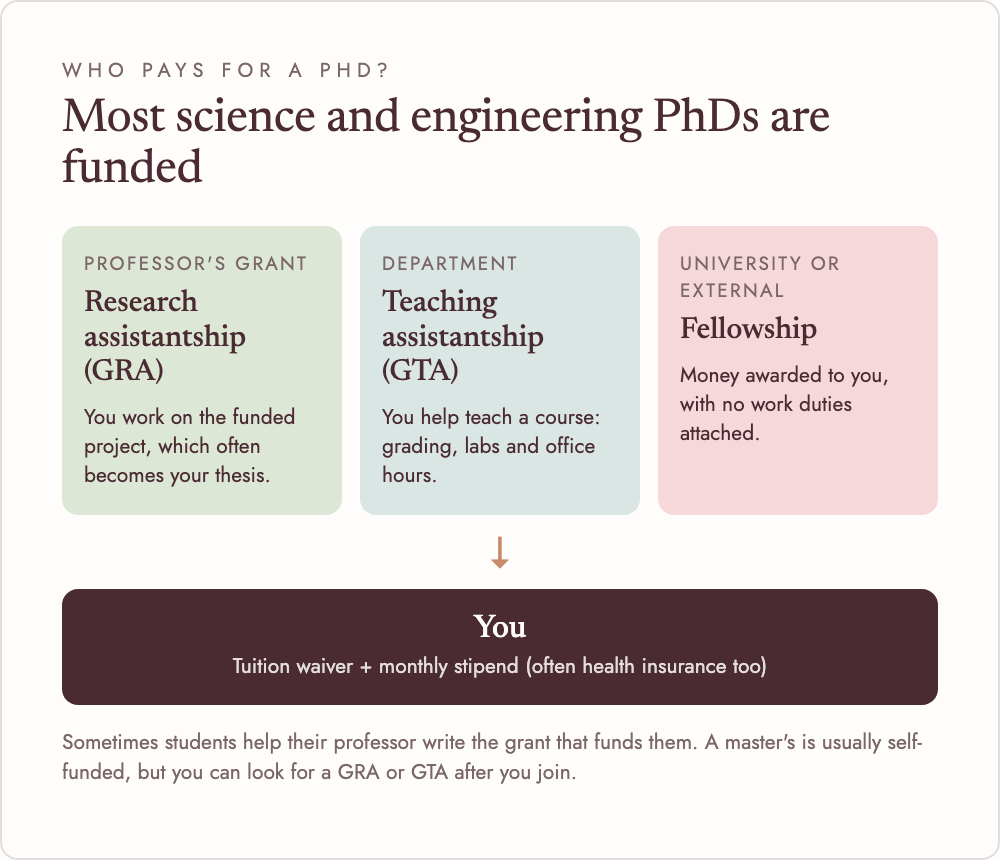
Graduate research assistantship (GRA)
As a GRA, you work on your professor's grant-funded research project. In practice, that project often becomes the core of your PhD thesis, so your job and your degree overlap. This is the most common way engineering PhD students are funded.
Graduate teaching assistantship (GTA)
As a GTA, you help teach a course: grading assignments, running labs or problem-solving sessions, and holding office hours. It's a common way to be funded, especially in your first year before you join a research group.
What do 0.5 FTE and 0.25 FTE mean?
You'll see these numbers in offer letters. FTE stands for "full-time equivalent":
- 0.5 FTE usually means about 20 hours of work a week. This is a standard full assistantship.
- 0.25 FTE usually means about 10 hours a week, with a smaller stipend.
A full assistantship usually comes with a monthly stipend, a tuition waiver and often health insurance. A 0.25 FTE position may cover less, sometimes only part of the tuition. This varies between universities and departments, so ask exactly what's covered before you accept.
On an F-1 student visa, you can't work more than 20 hours a week on campus while classes are in session (Study in the States), which is why most assistantships stop at 0.5 FTE.
Fellowships
Fellowships pay you directly, with no work duties attached. They're competitive, and many of the big US fellowships (such as the NSF Graduate Research Fellowship) are only open to US citizens and permanent residents. Some universities offer their own fellowships to top international applicants.
An honest note: funding is generally more secure in science and engineering, where professors bring in research grants. In many other fields there's less grant money, so more students depend on teaching assistantships or their own savings. Always ask a department how its students are funded, and for how many years.
The money reality
- A stipend covers a modest life. It's enough to live on, especially if you share an apartment, but don't expect to save much.
- Part-time work is limited. As an F-1 student you mostly can't take off-campus jobs, so your assistantship is your income.
- After graduating, F-1 students can usually work in the US on OPT (Optional Practical Training) for up to 12 months, and STEM graduates may apply for a 24-month STEM OPT extension.
Helpful, free resources
- EducationUSA: free, official advice on studying in the US, with centres in India run through USIEF.
- GradCafe: see when other applicants heard back from programs you've applied to.
Coming up next
- What a PhD actually looks like in the US: coursework, qualifying exams, research and the defense.
- Applying without a research background.
- My own path: From a corporate job to a US PhD (coming soon).
Ask me anything
If you're thinking about a PhD in the US, write to me: which field, how to email a professor, or what funding to expect. I'll answer what I can, and the best questions will become future posts.
Live. Lift. Level up. ♡