A beginner's guide to AI: start from scratch (2026)
AI can feel like something only big tech companies and PhDs understand. It isn't. If you can learn a new recipe or a new app, you can learn AI, one step at a time. This is the plain-language roadmap I wish someone had handed me, with the free resources I'd use if I were starting again today.
This post is the starting line: the basics, from scratch, for someone who has never written a line of code. If you're already past that, scroll to the end, where I've listed the deeper posts coming next.
Bookmark it, and don't try to do it all in a week. Slow and steady wins here.
First, a note on the name: AI or SI?
If you've followed the news lately, you may have seen "AI" being called something new. In September 2026, President Trump announced that the United States would officially call the technology "Super Intelligence," or "SI," and on September 30 he signed an executive order titled "Inaugurating the Era of Super Intelligence." It tells US federal agencies to use "Super Intelligence" and "SI" in place of "Artificial Intelligence" and "AI" in official documents and communications (The Register, The Washington Post).
Two things to know as a beginner:
- It's a new name, not a new technology. Everything in this guide (Python, machine learning, neural networks) is the same whichever name you use. You'll probably see "SI" in US government material and "AI" almost everywhere else: in courses, research papers, and job listings.
- In research, "superintelligence" already means something specific. It has long been used for a hypothetical future system that outperforms humans at almost everything, an idea made popular by Nick Bostrom's 2014 book Superintelligence. Today's tools are impressive, but that is not what they are. So when you read the word, check which meaning the writer has in mind.
I'll keep saying AI in this guide, because that's the word your courses and textbooks use. Now, let's start.
What AI actually is
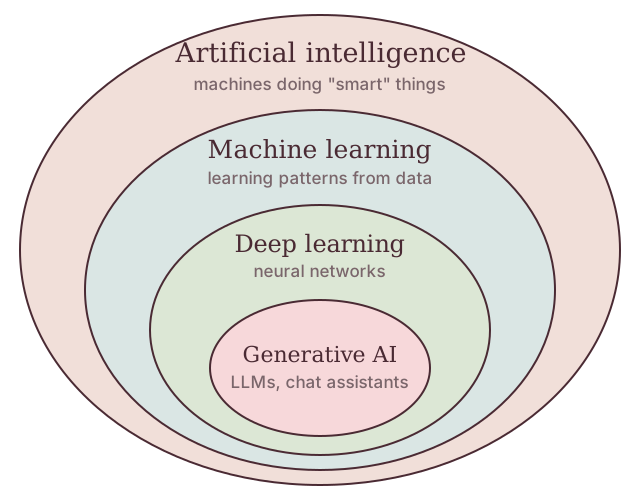
Artificial intelligence is any computer system that does something we'd normally call "smart": recognising a face, translating a sentence, recommending a song. Most AI today is built with machine learning, which means the computer learns patterns from lots of examples instead of following rules a person wrote by hand.
The three words you'll hear most
- Machine learning: learning patterns from data. Show a model thousands of emails labelled spam or not spam, and it learns to spot spam on its own.
- Deep learning: machine learning using neural networks, layers of simple maths that together can learn very complex patterns, like the meaning of a sentence or what's in a photo.
- Large language models: very large neural networks trained on huge amounts of text. They power chat assistants that can write, summarise, explain, and code.
Here's how they fit inside each other:
The roadmap at a glance
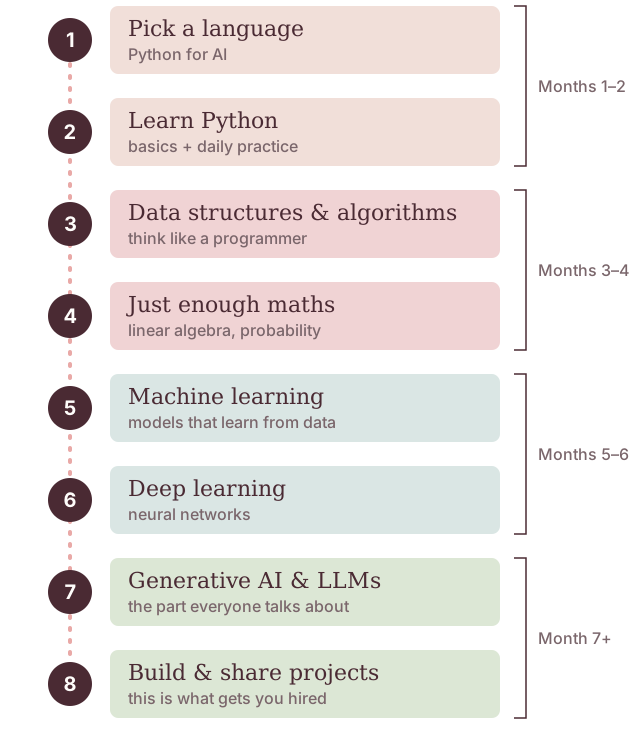
- Pick your first programming language
- Learn Python properly
- Learn data structures and algorithms
- Pick up just enough maths
- Learn machine learning
- Go deeper with deep learning
- Understand generative AI and LLMs
- Build projects and share them
You don't need to finish one step perfectly before peeking at the next. But this order saves a lot of confusion.
Step 1: How to pick your first coding language
This is where most beginners get stuck, so here's the honest answer: pick based on what you want to build, then stop worrying. Once you learn one language well, the second one is much easier, because the ideas (variables, loops, functions, logic) carry over.
- You want AI, data science, or research: Python. Nearly every major AI library and course uses it.
- You want to build websites and web apps: JavaScript.
- You want mobile apps: Swift (iPhone) or Kotlin (Android).
- You want coding interviews and competitive programming: Python works well; C++ and Java are also common.
- You want systems, games, or hardware: C or C++.
Since this is an AI guide, my recommendation is simple: start with Python. It reads almost like English, it's beginner friendly, and it's the language you'll use all the way from your first "Hello, world" to training neural networks.
Step 2: Get started with Python
You don't even need to install anything to begin. Google Colab lets you write and run Python in your browser for free.
Where to learn:
- The official Python tutorial: clear, free, and written by the people who make Python. Also see Python's getting started page.
- Harvard's CS50P: Introduction to Programming with Python: free lectures and problem sets. One of the best-structured beginner courses out there.
- GeeksforGeeks Python tutorial: great for quickly looking up a concept with short examples.
Where to practise:
- HackerRank: 30 Days of Code: one small challenge a day for 30 days. Perfect for building a daily habit.
- HackerRank Python practice: short problems sorted by topic and difficulty.
My tip: 30 to 45 minutes a day beats a 6-hour weekend marathon. Consistency is the whole game.
Step 3: Data structures and algorithms
This is where you learn to think like a programmer: how to store data sensibly and solve problems efficiently. It's also exactly what tech interviews test.
Learn these, roughly in this order:
- Arrays, strings, and lists
- Hash maps (dictionaries in Python) and sets
- Stacks and queues
- Recursion
- Sorting and searching (including binary search)
- Linked lists, trees, and graphs
- Big-O notation: how to describe how fast your code is
Resources:
- GeeksforGeeks DSA tutorial: explanations and practice problems for every topic above.
- LeetCode Top Interview 150: a curated study plan once you're comfortable with the basics.
Step 4: Just enough maths
You don't need to be a maths genius, but three areas make ML much less mysterious:
- Linear algebra: vectors and matrices, the language data is stored in. 3Blue1Brown's Essence of Linear Algebra makes it visual and genuinely beautiful.
- Probability and statistics: averages, spread, distributions, and uncertainty. Khan Academy Statistics and Probability is free and thorough.
- A little calculus: mainly the idea of a derivative (how a small change in input changes the output), which is how models learn.
Learn the maths alongside ML rather than before it. It sticks much better when you can see why you need it.
Step 5: Machine learning
The core ideas to understand:
- Supervised vs. unsupervised learning
- Regression (predicting a number) and classification (predicting a category)
- Training data vs. test data, and why you keep them separate
- Overfitting: when a model memorises instead of learning
- How to measure whether a model is actually any good
Resources:
- Machine Learning Specialization by Andrew Ng (Stanford and DeepLearning.AI, on Coursera): the classic starting point, rebuilt for beginners in Python.
- Google's Machine Learning Crash Course: free, practical, and well paced.
- Kaggle Learn: short, free, hands-on courses (Python, pandas, intro to ML) that run in your browser.
- scikit-learn: Getting started: the Python library you'll use for most classic ML.
- GeeksforGeeks Machine Learning tutorial: handy for quick refreshers on any algorithm.
Step 6: Deep learning
Now the neural networks: how they learn, and the main types (convolutional networks for images, sequence models and transformers for text).
- Deep Learning Specialization by Andrew Ng (DeepLearning.AI, on Coursera): five courses that take you from your first neural network to modern architectures. It's one of the most recommended deep learning courses for a reason.
- fast.ai: Practical Deep Learning for Coders: free and top-down. You build working models first and learn the theory as you go.
- 3Blue1Brown's neural networks series: the best visual intuition for what's happening inside a network.
If cost is a barrier for a Coursera course, check whether financial aid is available for it on Coursera.
Step 7: Generative AI and LLMs
This is the part everyone is talking about: chat assistants, image generators, and AI agents.
- DeepLearning.AI short courses: bite-sized courses on prompting, building with LLMs, and more.
- AI For Everyone by Andrew Ng: no coding needed. Great if you (or your parents, or your manager) want to understand what AI can and can't do.
Step 8: Build projects and share them
Courses teach you. Projects make you good.
- Start with Kaggle's Titanic competition: predict who survived, using real data. Almost everyone starts here.
- Then build something you care about: predict your city's rent prices, sort your photos by what's in them, or build a tiny chatbot that answers questions about your notes.
- Put your code on GitHub and write a short post about what you built and what went wrong. Sharing helps you learn, and helps the right people find you.
A realistic plan
- Months 1–2: Python basics, plus HackerRank's 30 Days of Code
- Months 3–4: data structures and algorithms, plus maths alongside
- Months 5–6: machine learning, and your first Kaggle project
- Month 7 onwards: deep learning, generative AI, and projects you're proud of
Life happens, and some months will be slower. That's fine. Just don't stop.
Three myths to drop
- "You need to be a maths genius." You need curiosity and consistency. The maths can come later, as you need it.
- "It's too late to start." The field keeps changing so fast that everyone is always learning. Beginners are welcome.
- "AI will do everything, so why learn?" People who understand AI are the ones who use it best.
Watch along: my playlists
I've collected the videos I'd actually point a beginner to into four playlists on the LiveLiftUp YouTube channel, in the order I'd watch them:
- LEVEL UP | Python Programming: a full beginner course, then core data structures and algorithms in Python.
- LEVEL UP | LeetCode & DSA: the key problem-solving patterns, then must-know problems.
- LEVEL UP | Machine Learning: the core ideas and classic algorithms, explained simply.
- LEVEL UP | Deep Learning & LLMs: neural networks, backpropagation, and how large language models work.
What's coming next
This guide is the foundation. Over the next few weeks I'm going deeper:
- My top 10 course recommendations (first week of October): the courses I'd actually spend time on, and the order to take them in.
- 3 months to break into AI (SI) (second week of October): a focused week-by-week plan for when you want to move fast.
- Already in the field? How to keep upgrading yourself (coming soon): for engineers, analysts, and researchers who want to stay sharp as everything changes.
Let's learn together
If you want help, or you're stuck on something specific (which language, which course, a bug that's driving you crazy, how to plan your path to a master's or PhD in AI), write to me. I'll try to answer, and your question might become my next post.
Start small, stay curious, and build. Let's learn together and level up. ♡