From research to the real world
I never set out to become "a scientist."
When I was younger, that word meant someone in a white coat in a lab, far away from real life. That wasn't the dream. What I wanted was simpler and harder to explain: I wanted to do work that mattered. Work that started with a question and ended with something useful to someone.
It took me years to realise that this is exactly what research is.
The people who made it look possible
Growing up in India, one name was everywhere: Dr. A. P. J. Abdul Kalam. An aerospace scientist who worked on India's space and missile programmes, went on to become the 11th President of India, and wrote about it all in his autobiography, Wings of Fire. What stayed with me wasn't the rockets. It was that he came from a small town and an ordinary family, and that he never stopped being a teacher.
He, and so many scientists whose stories I read, taught me something I still believe: research isn't about being the smartest person in the room. It's about being curious enough to keep asking, and stubborn enough to keep going when the answer is "not yet."
So what is research, really?
Strip away the jargon, and research is a simple loop:
- Ask a question nobody has fully answered yet.
- Read what others have already figured out.
- Form an idea about what might be true.
- Test it, honestly. Most of the time, it fails.
- Learn from the failure, adjust, and try again.
- Share what you found, so the next person starts a step ahead of you.
That's it. The difference between studying and researching is that in research, there is no answer at the back of the book. You are writing that page.
My path here
It wasn't a straight line.
- At IIT Gandhinagar, my master's thesis was on crowd counting and surveillance: teaching computers to look at a crowded scene and estimate how many people are in it.
- Then I spent a few years in industry as a data scientist, at eClerx and at Accenture, building things like language-processing tools and workforce analytics. That's where I learned what happens when a model meets real, messy data.
- Then I took the leap: a PhD in Electrical and Computer Engineering at Kansas State University. (That story is coming in From a corporate job to a US PhD.)
What I work on: networks
Almost everything I research comes down to one idea: the world is made of networks.
A power grid is a network: power plants, substations, and lines, all connected. So are a city's roads and water pipes, the internet, and your circle of friends. And in a network, what happens in one place rarely stays there.
Here are the questions I've spent the last few years on, without the equations.
Which parts of a system matter most?
If a storm knocks out a few pieces of a power grid, which failures would hurt the most people? Infrastructure systems also depend on each other (water needs electricity, hospitals need both), so one failure can ripple outward in ways that are hard to predict.
I use graph neural networks (GNNs), a kind of AI designed for connected data, to find those critical points quickly, so they can be protected before something goes wrong. This work was published at IEEE SmartGridComm (2023) and IEEE GreenTech (2024).
Who gets left behind?
Much of this was part of ARISE (Adaptive and Resilient Infrastructures driven by Social Equity), a Kansas-wide project funded by the US National Science Foundation's EPSCoR programme (NSF award 2148878). Its goal is to help communities, urban and rural, prepare for and recover from hazards and disasters.
The "social equity" part matters to me. When the power goes out, it doesn't affect everyone equally. Good resilience planning asks not just what will fail? but who will be hurt most, and how do we protect them?
How do ideas spread?
This one is called influence maximization. Imagine you want to spread an important message, like a public health campaign, through a community. You can only reach a few people directly. Who do you choose, so the message travels furthest?
Now make it harder: real networks keep changing. People connect and disconnect all the time. I worked on this problem for dynamic networks, in collaboration with Pacific Northwest National Laboratory (PNNL), using GNNs to predict which people are the best starting points. That work was accepted at an AAAI workshop in 2025.
Cause, or coincidence?
Two things happening together doesn't mean one caused the other. Causal inference is the set of tools for telling the difference, and it's what keeps data science honest.
From research to the real world
Here's why I love this work. When disasters hit, the systems we depend on (electricity, water, communication) need to keep running, or recover fast. A method that finds a weak spot in seconds instead of hours isn't just a faster algorithm. It's a decision-maker getting an answer in time to act.
That's the journey every piece of research hopes to make: from a question, to a paper, to something that changes a real decision for real people.
Where I look for inspiration
AI moves fast, so I follow the labs that are shaping it:
- Google DeepMind
- Anthropic
- Google Research
- Hugging Face, for open-source models and tools
I don't read everything. Nobody can. I pick a few sources and read them properly.
Thinking about research? Start here
You don't need a PhD to begin. You need curiosity and a little structure.
- Follow your questions. Notice what you keep wondering about. That's your topic.
- Read papers, slowly. Start with the abstract, the figures, and the conclusion. Search on Google Scholar and arXiv, and use Connected Papers to see how papers relate to each other.
- Reproduce one result. Take a paper you like and try to rebuild it. You'll learn more from this than from reading twenty papers.
- Find people. Email a professor or a PhD student whose work you admire, with one specific, thoughtful question. Many will reply.
- Write as you go. Notes, a blog, anything. Writing is how you find out what you actually understand.
- Expect rejection. Every researcher you admire has a folder full of rejected papers. It's part of the job, not a verdict on you.
Ask me anything
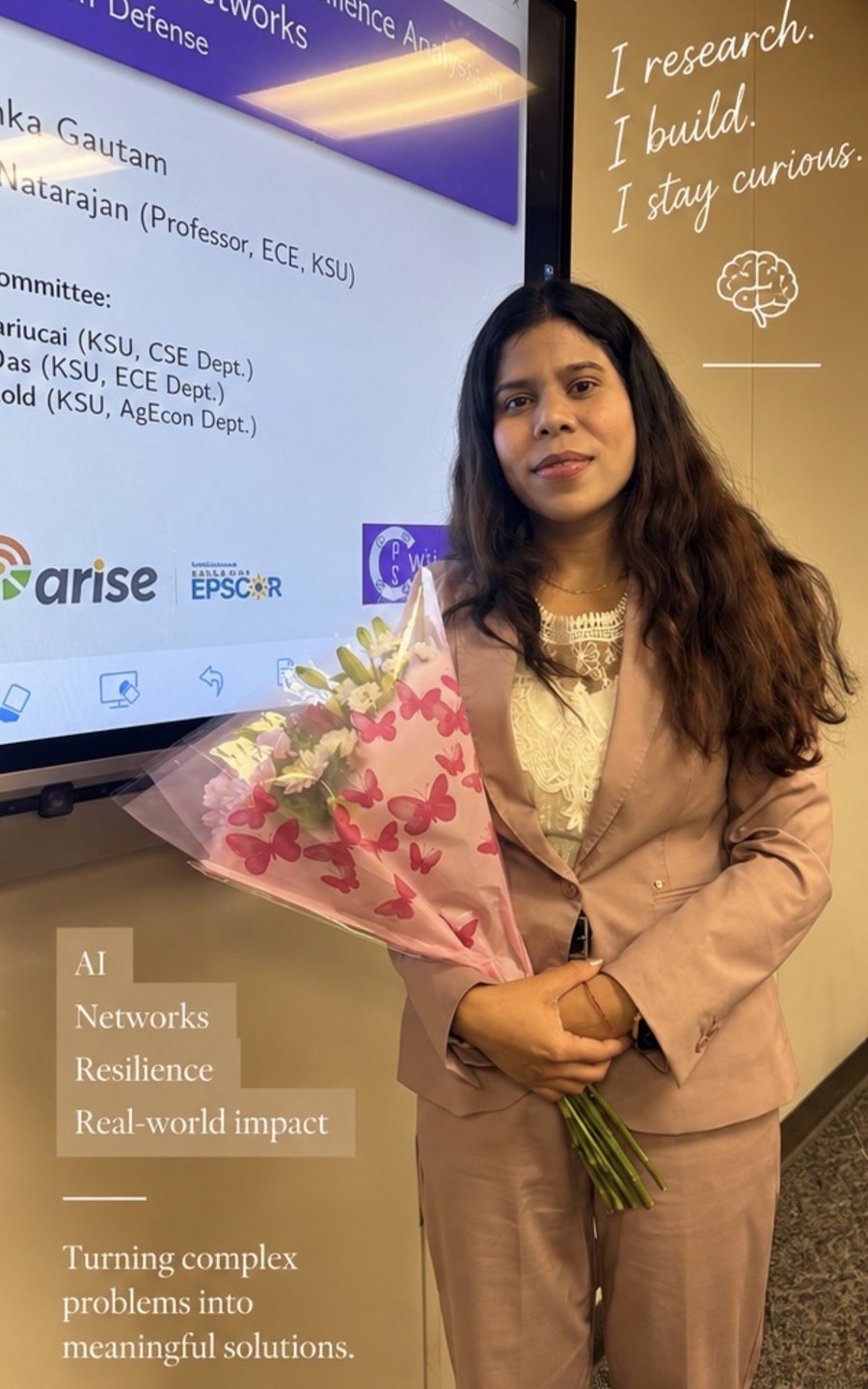
Standing next to my dissertation defense slides was a reminder of how far a curious question can take you.
If you've ever wondered whether research is for you, how to find a topic, how to apply for a master's or PhD, or what the day-to-day really looks like, write to me. I'll answer what I can, and the best questions will become future posts.
You can see my papers and projects on my research portfolio.
Stay curious. ♡