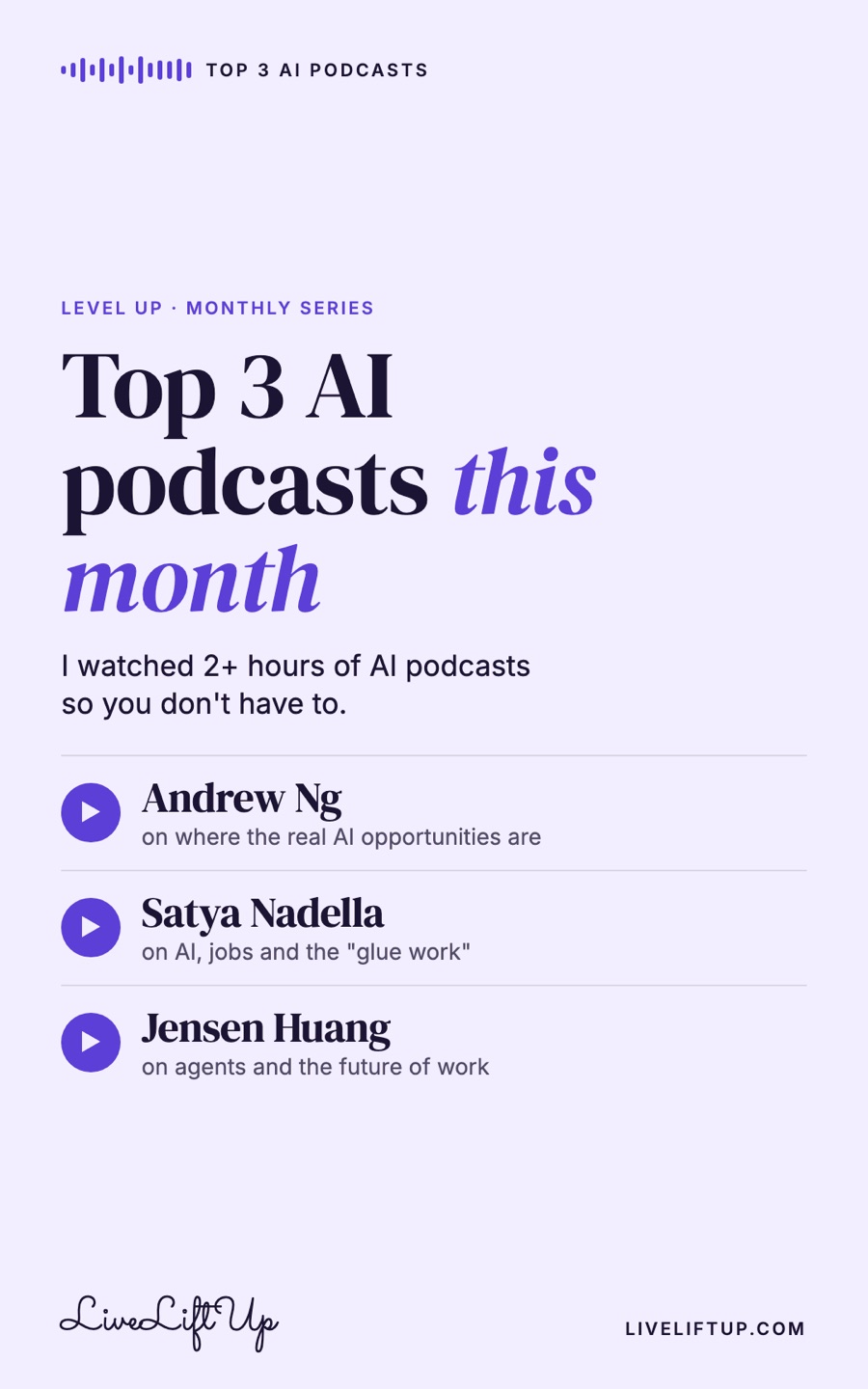
Top 3 AI podcasts this month: Andrew Ng, Satya Nadella and Jensen Huang
Every week there's a new AI podcast with a big name and a bigger headline. I can't watch them all, and you probably can't either.
Podcasts are a big part of my Saturday mornings: a slow start, a nice breakfast and a good conversation. (I wrote about that ritual in my Saturday morning podcast notes.) Half of what I listen to is about the mind and life. The other half is AI, because it's my work and, honestly, my curiosity.
So here's a new monthly series: my top 3 AI podcasts of the month, with the ideas worth keeping from each. This month, three people who shape the AI industry: Andrew Ng, Satya Nadella and Jensen Huang.
All three are in my YouTube playlist LEVEL UP | AI Podcasts, which I'll update every month.
The big picture
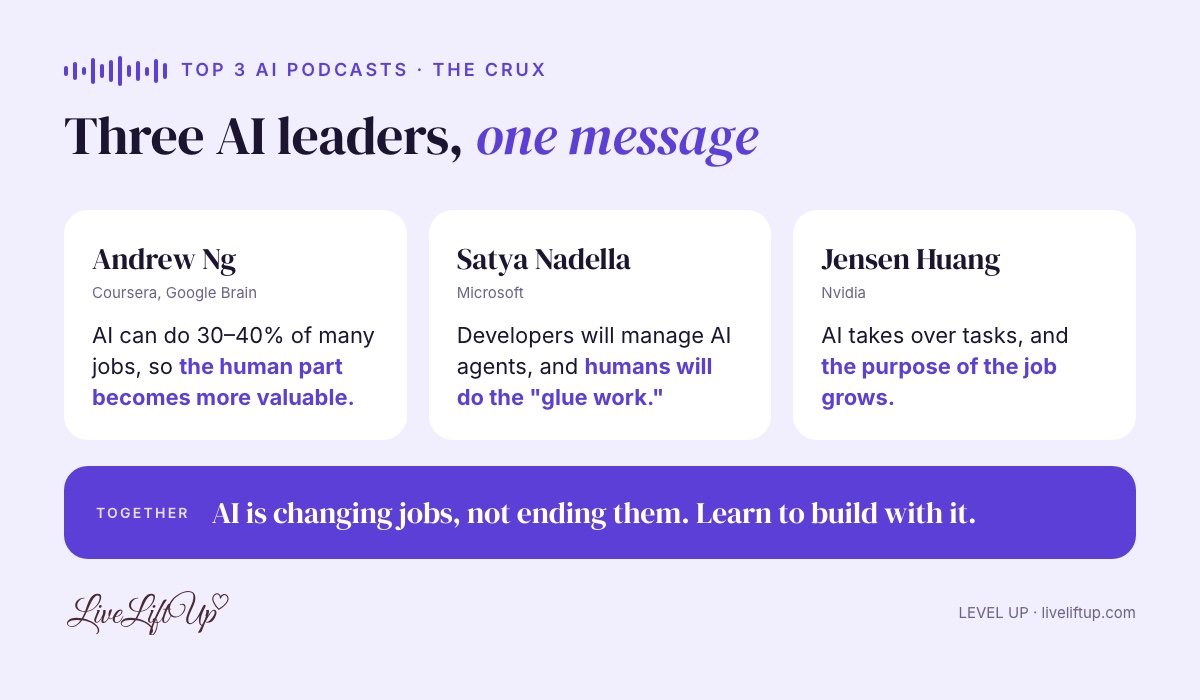
Three very different people, one clear message: AI is changing jobs, not ending them. The people who learn to build with AI will do best.
- Andrew Ng: AI can do maybe 30 to 40% of many jobs, which makes the human part more valuable. Learn to build with AI, not just use it.
- Satya Nadella: the work changes shape. Developers will manage many AI agents, and humans will do the "glue work" that holds everything together.
- Jensen Huang: jobs have a purpose and tasks. AI takes over tasks, and the purpose often grows. Become an expert at using AI, whatever you study.
Why these three? Between them, they cover the whole picture: Andrew Ng from education and learning, Satya Nadella from the workplace and software, and Jensen Huang from the hardware that powers all of it. If you only have time for one, start with Andrew Ng. It's the shortest and the most practical for students and career changers.
1. Andrew Ng: "The biggest opportunities in AI aren't where you think"
Watch on Silicon Valley Girl (about 38 min). Andrew Ng co-founded Coursera and the Google Brain team, and his courses have taught millions of people AI. (His Machine Learning course is in my AI guide.)
What stayed with me:
- The "job apocalypse" is overblown. If AI can do 30 to 40% of a job, the other 60 to 70% that humans do becomes more valuable. The risk is for people who keep working like it's 2022.
- Universities are slow to catch up. Courses take years to change, so he advises students to do well in their classes and learn the newest AI skills online.
- AI can be bad for learning. This one surprised me, coming from him. When AI does your homework, your scores go up, but you remember much less. Use it to get work done, but do the hard thinking yourself when you're trying to learn.
- Your "context advantage." Humans know things AI doesn't: what the customer's face said, what your manager really cares about. That context is what judgment and taste are made of.
- Everyone should build. On his team, even marketers and finance people build their own AI tools. His interview question for marketers: what have you built?
- Show agency. More job descriptions now ask for people who spot a problem and go solve it, without waiting to be told.
2. Satya Nadella on AI and jobs: "Humans will do the glue work"
Watch on Hard Fork (about 29 min), the New York Times tech podcast, recorded live in San Francisco.
What stayed with me:
- The typist analogy. In the early '80s, nobody would have believed the world needed billions of typists. Today almost everyone types, because the work turned into "knowledge work." He expects AI to change work in the same way.
- The developer's new job. Developers will manage hundreds of AI agents. One of his colleagues calls the new skill "cognitive coverage": really understanding code that agents wrote. You still need to learn computer science to do it.
- The glue work. Even with all our digital systems, humans do the work that connects everything. We'll discover new kinds of glue work as automation grows.
- Don't use frontier models for non-frontier problems. Using AI a lot isn't the goal. Using it for things that actually add value is.
3. Jensen Huang on the agentic future
Watch on the All-In Podcast (about 66 min). Jensen Huang co-founded Nvidia and is its CEO. Nvidia's chips power most of today's AI.
What stayed with me:
- From answers to work. People pay for information, but mostly they pay for work getting done. That's why AI agents, which complete tasks rather than just answer questions, are such a big shift.
- The radiology story. Years ago, a famous computer scientist predicted AI would replace radiologists. AI did become part of every radiology system, and yet the number of radiologists went up. Scans got faster, so more patients could be seen. Every job has a purpose and tasks: AI took over a task, and the purpose grew.
- His advice to students: deep science, deep maths and language skills still matter. "Language is the programming language of AI," so an English major could do very well. Whatever you study, become an expert at using AI.
More AI podcasts worth following
If you want to keep up with AI beyond my monthly picks, these are good places to start:
- Bloomberg Tech. My favourite for staying up to date. Short, regular updates on what's happening in AI and the companies behind it.
- Figuring Out with Raj Shamani. Not only about AI, but he's been bringing on so many big names, including tech founders and leaders. Great for the bigger-picture conversations.
- Hard Fork from The New York Times. A fun, easy weekly catch-up on tech news (Satya Nadella's episode above is from here).
- All-In. Investors and founders debating tech, AI and business (where the Jensen Huang interview is from).
- Lex Fridman Podcast. Very long, very deep conversations with AI researchers and founders. Perfect for breaking into two or three sittings.
- Dwarkesh Podcast. In-depth interviews with AI researchers. More technical, and very thoughtful.
- No Priors. Conversations with people building AI companies, good for seeing where the industry is heading.
- Lenny's Podcast. About product and careers, with lots of episodes on how AI is changing everyday work.
What I'm taking away
- Build something with AI every week, even something small. (My 3 months to break into AI plan has project ideas.)
- Use AI for doing, not for learning. When I'm learning something new, I'll work it out myself first.
- Focus on purpose, not tasks. What's the purpose of my work that AI can't take over?
Your turn
Which AI podcasts are you listening to? Send me your favourites and they might be in next month's top 3. And if you like the calmer side of life too, read this month's podcast notes on Huberman and Chopra.
Keep learning, keep building, level up. ♡