My Saturday morning podcasts: what a neuroscientist and a spiritual teacher taught me about a calmer mind
I'm honestly not a movies-and-TV-shows person. What I love is listening to people: how they think, what they've learned, how they see the world. Philosophy, self-help, big ideas about life. And I don't just like to listen. I like to watch the conversation happen, because a good conversation stretches my own thinking.
So podcasts have been part of my life for a long time. One small confession, though: I can't sit through a three-hour episode in one go. I break every long podcast into two parts, sometimes three, and come back to it over a few days. That way I actually finish it, and the ideas have time to sink in.
My Saturday morning ritual
Saturday is my slow morning. I take a break from the week, take it easy, make myself a nice breakfast, and put on a podcast. No rush, no to-do list, just a good conversation.
It has quietly become one of my favourite parts of the week. So I thought, why not share what I'm listening to with you?
The podcasts I keep coming back to
- Figuring Out with Raj Shamani. I'm really excited about this one right now. Raj has been inviting so many big names lately, and the conversations go deep. The Huberman episode below is from his show.
- Deepak Chopra. I've been following him for a long time. His talks on the mind and meditation are the ones I return to when I need to slow down.
- Bloomberg Tech for AI. It's my go-to for keeping up with what's happening in AI, and there's always something new.
Two podcasts that expanded my thinking
My podcasts usually fall into two very different categories. One is the calmer, inner side of life: the mind, habits, philosophy. The other is AI and technology, which is my work and my curiosity. (For that side, read my top 3 AI podcasts this month.)
This post is the calmer side. Two people from completely different worlds: a neuroscientist and a spiritual teacher. And somehow, they ended up saying surprisingly similar things.
I'm sharing the ideas that stayed with me, so you get the best of them in a few minutes. If one speaks to you, the full episode is linked, and both are in my YouTube playlist: LIVE | Podcasts Worth Your Time.
The big picture
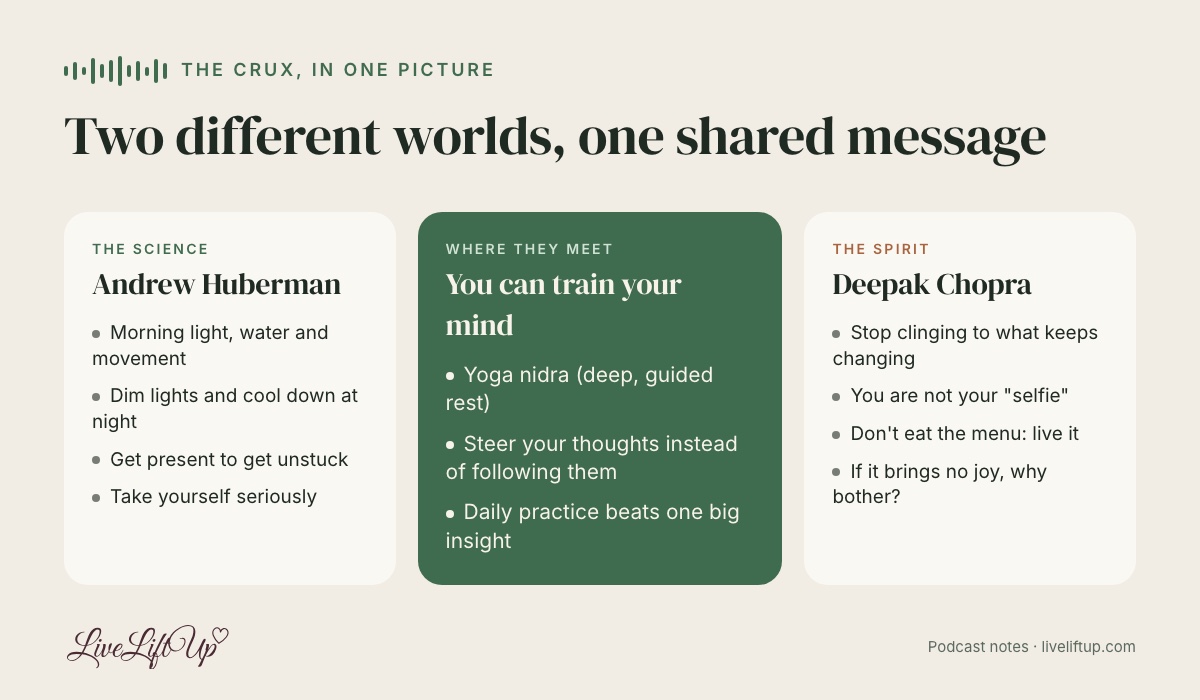
Huberman: your energy, focus and sleep follow a daily rhythm, and a few simple habits (morning light, winding down at night, learning to switch off) set that rhythm up.
Chopra: most of our suffering comes from clinging to things that are always changing, and from mistaking our thoughts for who we are.
Where they meet: both say you can learn to steer your mind. Both recommend yoga nidra, the ancient Indian practice of deep, guided rest. And both say it takes daily practice, not a one-time insight.
Episode 1: Andrew Huberman on daily habits
Andrew Huberman: Become Mentally Dangerous With These Daily Habits, on Figuring Out with Raj Shamani (about 2 h 45 min).
Andrew Huberman is a neuroscientist at Stanford and the host of Huberman Lab. My notes:
1. High cortisol in the morning, low at night
This was his biggest point. Cortisol gets called the "stress hormone," but he explains it's also what gives you energy and focus. He said that if he only had five minutes with someone, this is what he'd tell them: get a strong cortisol peak in the first hour or two of your day, and keep it low in the last hour before bed. That pattern supports daytime energy, focus, learning, mood and deep sleep.
How to get the morning peak:
- Get outside for 5 to 10 minutes of morning light (longer on cloudy days).
- Drink water and have your tea or coffee.
- Move a little: a walk, some jumping jacks, anything light.
And at night: dim the lights and let your body cool down. Both help melatonin, the hormone that helps you fall asleep, do its job.
2. A trick for falling back asleep
He opened the episode with this one. If you can't sleep, keep your eyes closed and slowly move them side to side, then in circles, then gently towards the tip of your nose, and exhale. The idea: to fall asleep, your brain needs to "forget" where your body is in space, and this helps it let go.
3. Yoga nidra, which he calls "NSDR"
He's a huge fan of yoga nidra, and he's careful to credit its origins in India. (He calls it non-sleep deep rest, or NSDR.) You lie down, breathe with long exhales, and move your attention from thinking and planning into pure sensation: what you hear, what you feel. He says it's one of the most powerful tools for learning to switch off.
This made me smile, because I've been trying short yoga nidra sessions myself. (More in Getting started with yoga.)
4. You can learn to steer your thoughts
He described thoughts like a ball rolling on a surface. The more you dwell on something, the deeper the groove gets, until you're stuck in it. His way out: get very present. Take a sip of water, notice the sounds around you, notice how the air feels. Every stressful moment is a small chance to practise. "The more stress, the more opportunity."
5. Take yourself seriously (and still have fun)
His advice to people in their 20s: take yourself seriously. Not in a rigid, no-fun way, but so you don't just drift towards whatever the people around you are doing. He also said that in the first few years of building something, you can go "all gas pedal," and after that, the work is learning balance.
Episode 2: Deepak Chopra on the mind and reality
Mind, Memory & The Multiverse: What is Reality? | Deepak Chopra, on the Know Thyself podcast with André Duqum (about 70 min).
Deepak Chopra trained as a medical doctor before he became one of the best-known voices on meditation and consciousness. This conversation is more philosophical, so here's what I took from it in plain words:
1. The five kleshas: what holds us back
From yoga philosophy, the five kleshas are the things that cloud the mind. As he explains them:
- Not knowing the difference between how things appear and what's really there.
- Clinging to experiences that are always changing. He compared it to holding your breath: hold on too long and you suffocate.
- Pushing away that same change.
- Confusing yourself with your "selfie": the image, the ego, the story you tell about yourself.
- Fear of death.
He says they're all connected: loosen the first one and the others start to loosen too.
2. Don't eat the menu
I loved this line. Living through ideas about life instead of life itself is "like going to a restaurant and eating the menu." Books, philosophies and teachers can point the way, but they're maps. You still have to experience the territory yourself.
3. Turn challenges into opportunities
When he was asked about grief and pain, he said that a lot of our suffering is recycled: old hurt that keeps coming back as anger, guilt or low energy. His suggestion is to go back to awareness itself, which he describes as a space of possibilities, so you can respond in a new way instead of on autopilot.
4. His daily practice
He's "fanatical" about one thing: his morning practice of yoga and meditation. He doesn't start work until 11, and he ends the day with yoga nidra. His test for any practice, spiritual or not: if it's not bringing you joy, why bother? And his best teachers for joy: children, who are curious and take risks without needing a reason.
5. On technology
He said our technology has grown faster than our emotional and spiritual maturity. The same tools that could do great harm could also help us solve our biggest problems. The choice is ours.
What I'm taking away
- Mornings: light, water, movement, before my phone.
- Evenings: dim lights and yoga nidra a few times a week.
- During the day: when my mind gets stuck in a groove, get present for a moment.
- And Chopra's test: if a habit isn't bringing me any joy, it's worth asking why I'm doing it.
Your turn
Which one would you watch first? And tell me your favourite podcasts. I'm always looking for my next Saturday morning listen, and your picks might end up in next month's notes.
Every month I'll share podcast notes from my Saturday mornings here, along with my top 3 AI podcasts for the tech side of life.
Slow mornings, big conversations. ♡