The clocks just fell back: how to reset your sleep and energy this week
Early this morning, on November 1 at 2 a.m., most of the US turned the clocks back one hour. Daylight saving time has ended, and we got an extra hour.
Sounds like a gift, right? For many people it is. But the darker evenings that follow can leave you tired by 5 p.m., wide awake at 5 a.m., and a bit low for weeks. Searches for "daylight saving time" spike every March and November, and this year they reached their highest level in five years. So clearly, a lot of us feel it.
Here's a simple reset, based on what sleep science says and on what Andrew Huberman explained in a podcast I watched recently.
The big picture
Your body runs on an internal clock, and light is what sets it. Morning light tells your body "the day has started." Darkness in the evening tells it "time to wind down."
The clocks changed, but your internal clock didn't change with them. You can help it catch up by being smart about light, timing and routine for a few days.
Why "falling back" still affects us
The Sleep Foundation explains that the November change is usually easier than the spring one, because we gain an hour rather than lose one. Still, some people struggle with the new wake-up time, and the effects can last a few days or even weeks.
The bigger change is the light. After the switch, it gets dark much earlier in the evening, and many of us get less daylight overall. That can affect our energy and mood through the winter.
Your 5-day reset plan
Start today and keep going through Thursday (Nov 1–5):
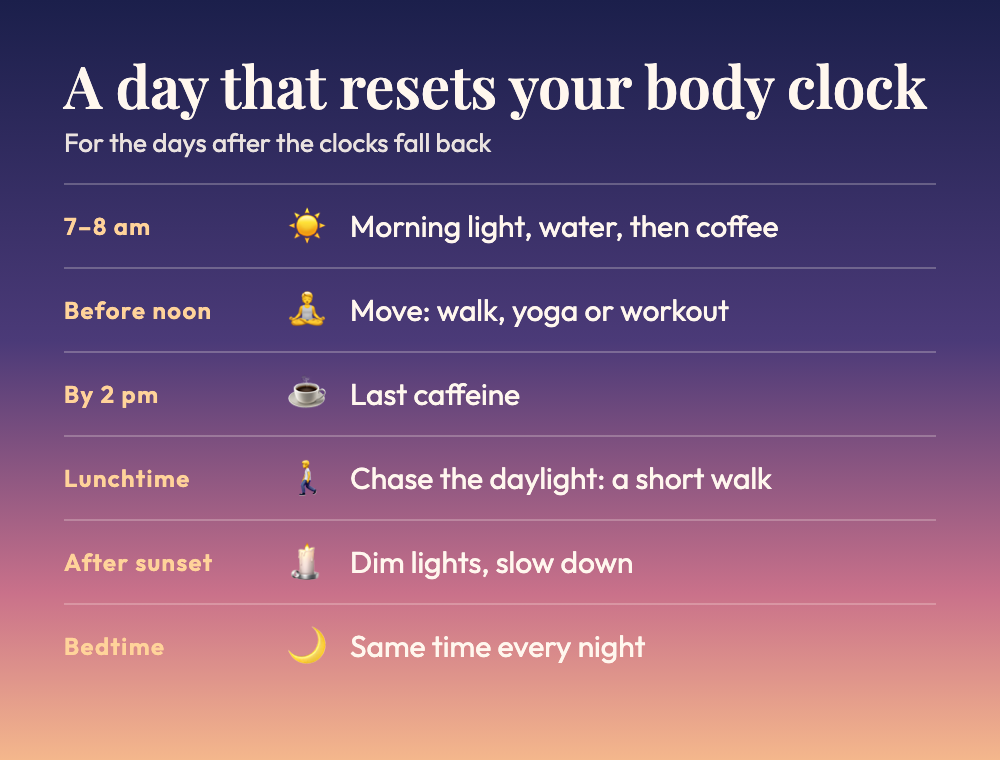
- Keep the same wake-up time every day, using the new clock. Try to go to bed at a steady time too, even if you feel sleepy early.
- Get morning light, every day. Go outside within an hour of waking, for 5 to 10 minutes, or longer when it's cloudy. Huberman explains that morning light helps create the energy peak early in the day that sets you up for focus during the day and better sleep at night.
- Move early. A walk, yoga or a workout in the first half of the day helps set your clock. (My 10-minute morning yoga counts.)
- Keep caffeine to the morning and early afternoon.
- Dim the lights in the evening. Bright light late at night tells your brain it's still daytime. Use lamps instead of ceiling lights, and put your phone away for the last half hour before bed.
And two more things:
- Use the extra hour well. Spend it today on something that refuels you: a slow breakfast, a long walk, a journal.
- Chase the daylight. With dark evenings, a walk at lunchtime becomes your most valuable daylight.
If you can't fall asleep
Two tools I learned from Huberman's episode:
- Yoga nidra (NSDR): a guided practice of deep rest, lying down and focusing on your breath and body. Ten minutes can calm your mind before sleep. There are some in my LIVE | Meditation & Breathwork playlist.
- The eye trick: with your eyes closed, slowly move them side to side, then in circles, then gently towards the tip of your nose, and exhale.
If the darker months get to you
Feeling a bit lower in winter is common. But if it lasts, affects your daily life, or feels heavy, please talk to a doctor. There are effective treatments, and you don't have to push through on your own.
Your turn
Do you love or hate the time change? Tell me how you're feeling this week. ♡
This post is for general information, not medical advice.