A day that feels like me
Not every day looks like this, but the good ones do.
Let me be honest about what a researcher's day can turn into if I'm not careful: checking email every ten minutes, refreshing a submission portal, half-reading a paper while replying to a message, and reaching 6 pm tired with nothing really finished. I've had plenty of those days.
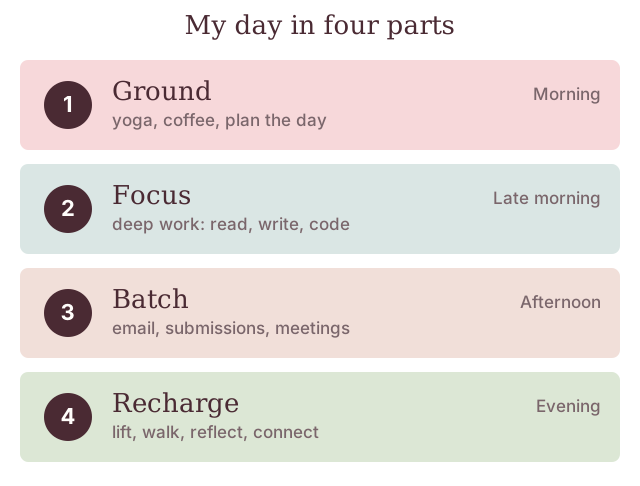
So over the years I've built my days around how the mind actually works, instead of fighting it. I think of a good day in four parts.
Part 1: Ground (morning)
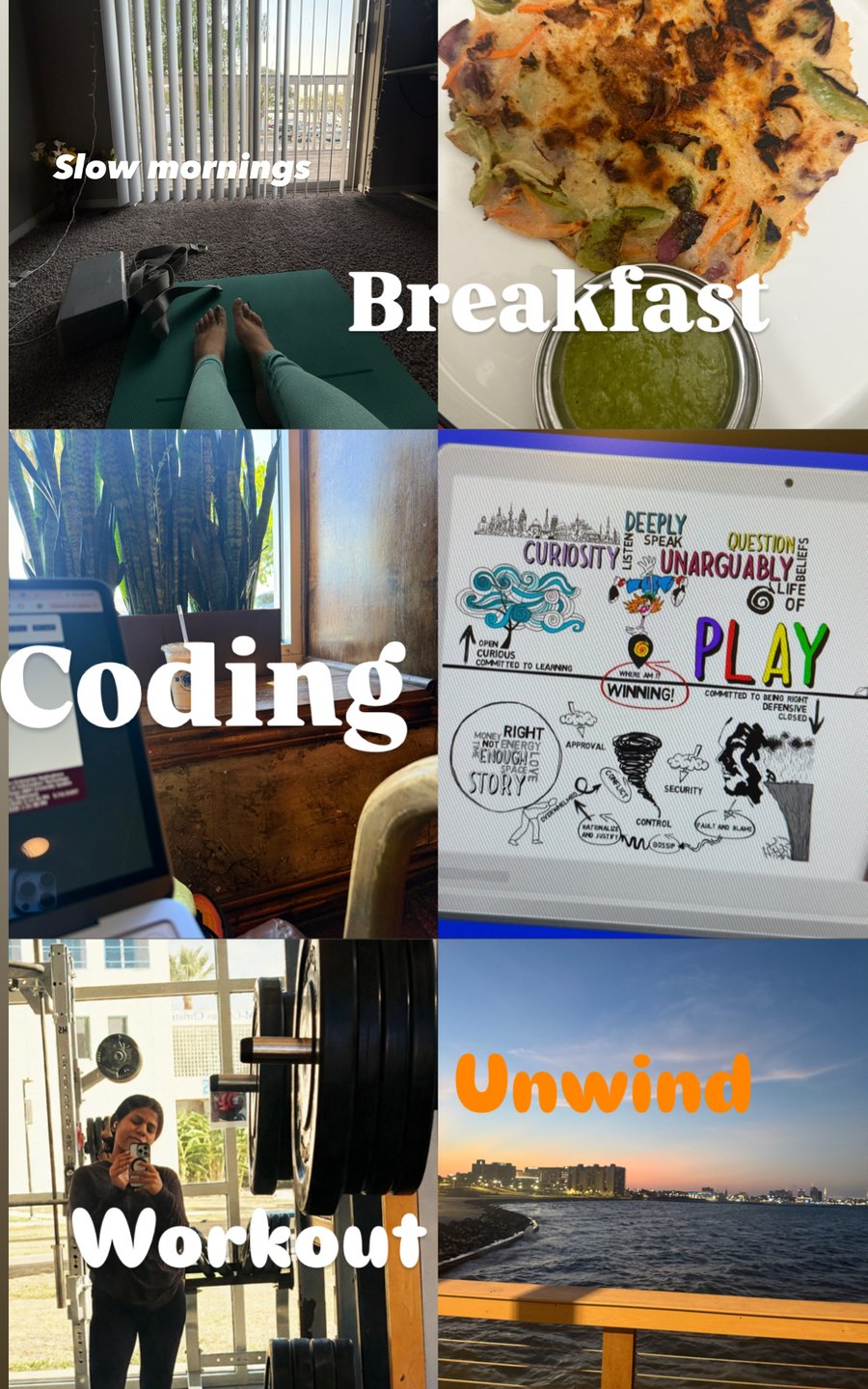
Yoga first. I start on my mat. A bit of stretching, some quiet, and no phone for the first few minutes. It sets the tone for everything after. (My full guide: Getting started with yoga.)
Then coffee. I love coffee. Not just the caffeine: the ritual. Making it slowly, holding the warm cup, taking that first sip before the day asks anything of me. It's my signal that the day has started.
Breakfast. Something warm and homemade, loaded with veggies, with green chutney on the side. A little taste of home goes a long way.
And a plan. Before I open my laptop, I write down the three things that would make today a good day. Not twenty. Three. If I skip this step, my inbox decides my day for me.
Part 2: Focus (late morning)
This is when my mind is sharpest, so it gets the hardest work: reading papers closely, writing, coding, thinking through a problem that doesn't have an answer yet.
The rule for this block is simple: one thing at a time.
Netflix's The Mind, Explained has a short episode called "How to Focus" (season 2) that changed how I see this. Its message: we are not built to multitask. What feels like doing two things at once is really switching quickly between them, and every switch costs something. A lot of our interruptions aren't even from other people. We interrupt ourselves.
Researchers have a name for that cost. Sophie Leroy calls it attention residue: when you jump from one task to another, part of your attention stays stuck on the first one, and you do the next thing worse (Leroy, 2009).
What helps me:
- The Pomodoro Technique: work for 25 minutes, break for 5, and take a longer break after four rounds. Francesco Cirillo came up with it as a student, using a tomato-shaped kitchen timer (pomodoro is Italian for tomato). On days when starting feels impossible, "just one pomodoro" gets me moving.
- Phone out of reach, notifications off, email closed. Not minimised. Closed.
- Hardest task first. If I do the thing I'm avoiding before lunch, the rest of the day feels lighter.
Part 3: Batch (afternoon)
After lunch my energy dips, so I stop pretending I can do deep thinking and give this block to everything small.
As a researcher, the small things never end: emails from collaborators, reviewer comments, submission deadlines, forms, meeting notes, scheduling. If I let them, they leak into every hour of the day.
So I batch them. Instead of checking email all day, I open it at a few set times and clear it in one go. This isn't just a preference. In one study, people who were limited to checking email three times a day felt significantly less stressed than when they could check as often as they liked (Kushlev & Dunn, 2015).
Other things that go in this block:
- Time blocking: meetings and calls get grouped together, so they don't chop up my focus time.
- The two-minute rule: if something takes less than two minutes, I do it now instead of adding it to a list.
- A short TED talk. Almost every day I watch one TED talk, usually with my afternoon coffee. Ten or fifteen minutes on something completely outside my field. It's my favourite way to stay curious. I've saved the ones that stayed with me in a playlist: LIVE | TED Talks & Big Ideas.
- Catching up on reading. A few tech blogs I keep going back to: The Batch for weekly AI news, the Google Research blog, the Hugging Face blog, and Lil'Log for deep, clear explanations.
A mindset check
Somewhere in the day, I pause for this. I came across a drawing that stuck with me: above the line, you're open, curious, and committed to learning; below it, you're defensive, closed, and committed to being right. I try to notice which side of the line I'm on, especially on hard days: a rejected paper, an experiment that failed, feedback I didn't want to hear.
Part 4: Recharge (evening)
Lift. Lifting is non-negotiable for me. It clears my head better than anything else. (More on that in Strong mind, strong body.)
Walk. Honestly, I love walking. It gets my steps in, but that's the smallest part. A walk is where my day finally makes sense: what went well, what went wrong, what I'd do differently tomorrow. Stanford researchers found that people come up with more creative ideas while walking than while sitting (Oppezzo & Schwartz, 2014), and I believe it. My best ideas rarely arrive at my desk.
Dogs. I am that person who watches every dog on the trail. If I get to meet one, the walk was worth it. No further questions.
Gratitude. Somewhere on the walk I think of a few things I'm grateful for. It sounds small, and it's backed by research: in a well-known set of studies, people who regularly wrote down what they were grateful for reported higher well-being than those who wrote about hassles (Emmons & McCullough, 2003).
Friends. Some evenings I call a friend and we walk and talk, in two different cities, sometimes two different time zones. A good chat and a walk fix most things.
Unwind. I end by the water, watching the city lights come on as the sky turns pink. Grateful for the day, whatever it held.
Sneak peek: my planning system
People ask how I keep track of all of it: research, writing, workouts, this blog. The honest answer is that I've become a little obsessed with planning, and lately with Notion.
In November I'm writing a full post on how I plan, organise, and learn, with a look inside my Notion setup. Consider this your sneak peek.
Try it
You don't need my exact day. Just try the shape of it: ground, focus, batch, recharge. Protect one block for your hardest work, give the small stuff its own time, and end the day moving.
What does a day that feels like you look like? Write to me. I'd love to know.
Work, lift, fuel, unwind. Simple, and completely mine. ♡
Sources
- The Mind, Explained, season 2, "How to Focus" (Netflix, 2021).
- Leroy, S. (2009). Why is it so hard to do my work? The challenge of attention residue when switching between work tasks. Organizational Behavior and Human Decision Processes, 109(2), 168–181. doi:10.1016/j.obhdp.2009.04.002
- Kushlev, K., & Dunn, E. W. (2015). Checking email less frequently reduces stress. Computers in Human Behavior, 43, 220–228. doi:10.1016/j.chb.2014.11.005
- Oppezzo, M., & Schwartz, D. L. (2014). Give your ideas some legs: The positive effect of walking on creative thinking. Journal of Experimental Psychology: Learning, Memory, and Cognition, 40(4), 1142–1152. doi:10.1037/a0036577
- Emmons, R. A., & McCullough, M. E. (2003). Counting blessings versus burdens: An experimental investigation of gratitude and subjective well-being in daily life. Journal of Personality and Social Psychology, 84(2), 377–389. doi:10.1037/0022-3514.84.2.377